
When Jaw Pain, Headaches, and Clicking Are Trying to Tell You Something
Do you wake up and say, “My face is really hurting me right now, and my jaw is really tight”? Or do you wake up with headaches, jaw soreness, or tight muscles in your face and neck? Or maybe your jaw clicks when you chew. Maybe it feels tired after eating. Some people notice ear pain, ringing in the ears, muffled hearing, dizziness, or even migraines that never seem to fully go away.
Most people assume these problems are unrelated, but in many cases, they can all point back to one thing: a TMJ disorder. TMJ problems are incredibly common, yet they are often misunderstood or misdiagnosed. Many patients spend years treating the symptoms without ever discovering the actual source of the problem.
Identifying the Cause Makes Treatment Possible
Here in Fair Oaks at Orcutt Family Dentistry, we regularly see patients who have been suffering for years before realizing their bite and jaw function may be contributing to their discomfort.
The good news is that once the underlying issue is identified, treatment can often provide significant relief and improve quality of life.
TMJ symptoms can be frustrating because they don’t always seem connected, and many medical professionals just don’t receive much training on TMJ. Some patients experience only mild jaw clicking. Others develop chronic headaches, facial tension, worn teeth, or pain that affects their ability to eat, sleep, or focus during the day.
There are many signs and symptoms of TMJ disorder and you may have TMJ disorder if you experience jaw pain or soreness, clicking or popping in the jaw joint, frequent headaches or migraine’s, facial muscle fatigue, neck and shoulder tension, ear pain or ringing in the ear (tinnitus), difficulty opening your mouth fully, jaw locking, cold sensitivity, pain while chewing, uneven bite feeling, dizziness or balance issues, pain around your temples and above your ear.
Many patients are surprised to learn that the jaw joint is closely connected to the muscles of the head, neck, and face. When the bite is unstable or the jaw muscles are overworking, the body can begin compensating in ways that create chronic tension and inflammation.
The Longterm Impact of Untreated TMJ Disorders
In some cases, patients may unknowingly grind or clench their teeth at night for years. Others may have a bite imbalance that forces the jaw muscles to work harder every time they chew or swallow.
The symptoms typically get worse over time. Occasionally, patients say that their TMJ disorder got better on its own, but that means the body found a way to compensate, which is not a good thing for the joint.
One of the most frustrating parts of TMJ disorder is that patients are often told everything “looks normal.” X-rays may appear healthy. Teeth may seem fine. Yet the pain and symptoms continue, which can feel discouraging and exhausting.
Many TMJ sufferers begin avoiding certain foods, limiting social activities, or simply learning to “live with it.” Some become dependent on pain relievers, muscle relaxers, or nightguards that help temporarily but never fully solve the problem. If that sounds familiar, you are not alone.
Understanding the Causes
The first step toward treating TMJ disorder is understanding what may actually be causing the problem. TMJ symptoms can have multiple contributing factors, including bite instability, clenching and grinding, muscle hyperactivity, trauma or injury, stress-related muscle tension, uneven tooth contacts, missing and shifting teeth, and poor jaw alignment.
At Orcutt Family Dentistry, we take a comprehensive approach to evaluating TMJ problems.
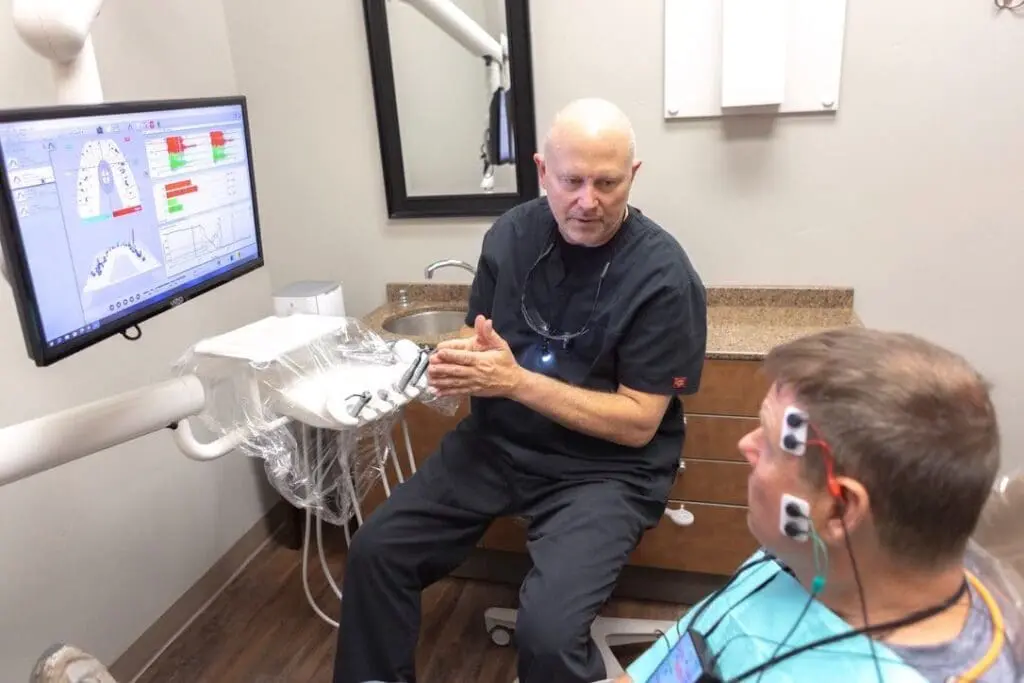
Dr. Brian Orcutt will examine jaw movement, look for muscle tenderness, perform a digital bite analysis with a bite computer (T-Scan), perform joint sound evaluation, take a 3D X-ray of the jaw joint with our cone beam, and discuss habits and symptoms.
One of the biggest advancements in modern TMJ treatment is the ability to digitally measure bite force and timing (using the T-Scan) and to determine the exact joint situation using joint vibration analysis (JVA). All this testing is completely pain-free and easy for anyone to do.
Even tiny bite imbalances can force certain muscles to overwork thousands of times per day. Over time, this can contribute to inflammation, tension, and pain.

Treatment Options at Orcutt Family Dentistry
We are proud to treat our patients in Fair Oaks with the most high-tech equipment available for treating and diagnosing TMJ problems. Using technologies such as T-Scan (to analyze the bite), BioEMG (to analyze the muscles), and the JVA (to analyze joint sounds and vibrations) it is possible to evaluate how the teeth come together and how the muscles and jaw respond during function.
For some patients, treatment may involve a custom orthotic or nightguard, and for others, adjusting the bite relationship using the advanced DTR method may be recommended. DTR stands for Disclusion Time Reduction. DTR treatment focuses on reducing prolonged frictional contacts between teeth during jaw movement. By improving how the teeth glide against each other, muscle hyperactivity can often be reduced, significantly improving symptoms.
Many patients report reduced headaches, less jaw tension, better chewing comfort, reduced facial pain, improved neck muscle comfort, better sleep quality, and reduced clenching awareness. Not every patient requires extensive treatment, though. Sometimes conservative therapy, habit awareness, bite stabilization, or protective appliances may be enough to significantly improve symptoms.
The key is proper diagnosis.TMJ symptoms are highly individual, which means treatment should also be individualized and not a one-size-fits-all approach. Unfortunately, many patients spend years chasing symptoms without fully evaluating how their bite and jaw function may be contributing to the problem.
Why Early Treatment Matters
TMJ issues often progress slowly. What starts as occasional clicking can eventually become chronic muscle pain, tooth wear, fractures, gum recession, or limited jaw opening. Ignoring symptoms may allow inflammation and muscle strain to continue for years.
Early intervention may help protect teeth from excessive wear, reduce chronic muscle tension, prevent worsening symptoms, and improve sleep and quality of life.
Another very important idea that people don’t understand is that if your teeth don’t touch properly, it can lead to many dental problems that tend to be painful and costly to fix down the road. These include a reduced likelihood of gum disease, fewer fractured teeth, a lower chance of needing a root canal, and a lower likelihood of losing a tooth. So treating your TMJ signs and symptoms early really reduces the risk of having a lot of dental treatment in your future.
TMJ Symptoms Are Often Overlooked
One reason TMJ disorder is frequently missed is that the symptoms can resemble many other conditions. A lot of times, patients go to their physician for headaches, an ENT for ear problems, a chiropractor for neck pain, a neurologist for migraines, and a massage therapist for chronic muscle pain.
While those providers can absolutely help with symptom management, the underlying dental or bite-related component may still remain unaddressed. That’s why a comprehensive TMJ evaluation can be so important.
TMJ Treatment Can Change Your Life
If you are experiencing jaw pain, headaches, clicking, clenching, facial tension, or other TMJ-related symptoms, it may be time to investigate the underlying cause rather than continuing to manage the symptoms alone.
At Orcutt Family Dentistry, we provide comprehensive TMJ evaluations using advanced technology to help identify bite imbalances and muscle dysfunction that may be contributing to discomfort. We are proud to offer this service to patients in Fair Oaks, Carmichael, Gold River, Roseville, Orangevale, Citrus Heights, and Sacramento.
Our goal is to help patients understand what is happening, why it may be occurring, and what treatment options may help improve comfort and function.
If you have been struggling with TMJ symptoms and are looking for answers, we invite you to schedule an evaluation with our team. You can simply call us to schedule a consultation or click on the link here for a FREE virtual consultation, and you won’t even need to leave your house.
You do not have to simply “live with it.”