

Why Bite Paper Alone Does Not Tell the Whole Story
Most patients are familiar with bite paper. You bite down, move your teeth around, and the paper leaves colored marks on the teeth. Bite paper is useful, but it has limitations. Studies have found that dentists interpret the blue bite marks accurately only 14% of the time. Blue bite paper is useful though, when combined with the T-Scan data.
Bite paper can show where teeth touch, but it does not accurately show which tooth touches first when closing and grinding, how long the teeth stay in contact, how the force changes over a period of time, and whether the jaw muscles become more active during the movement.
This matters because two bite marks can look very similar, but one may be much more significant than the other. A large mark is not always the strongest contact, and a small mark is not always insignificant.
DTR adds another layer of information. With digital bite analysis, we can evaluate bite timing and force patterns in a much more objective way. When combined with jaw muscle testing, we can also observe how the muscles respond during certain movements.
For patients with jaw muscle pain, headaches, migraines, neck pain, clenching symptoms, or unexplained tooth stress, that information can be extremely valuable.
The Technology Behind DTR
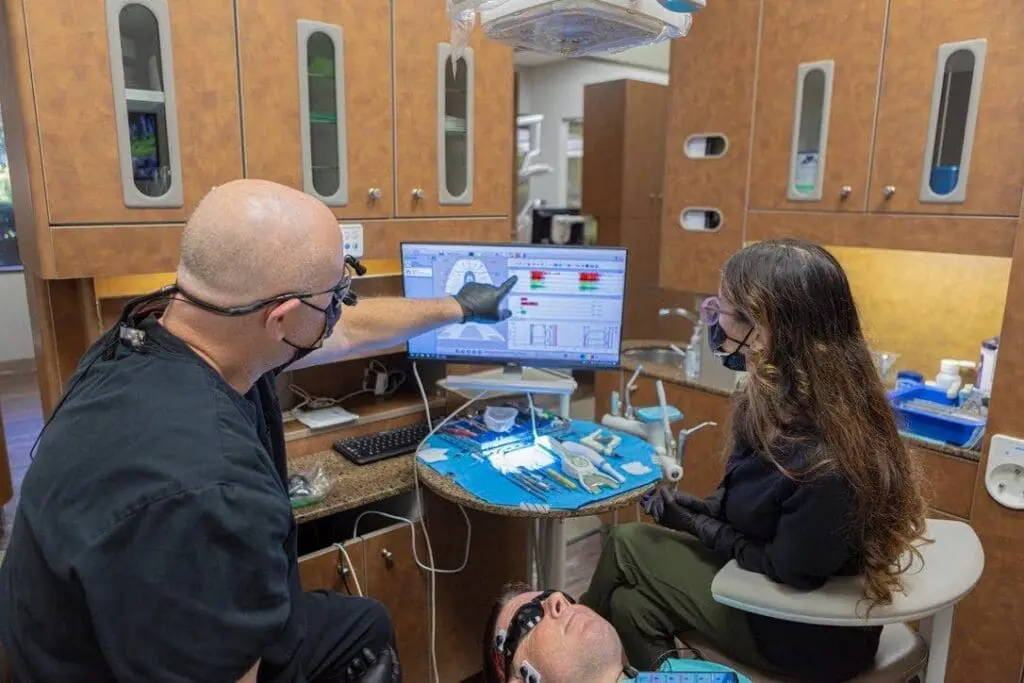
DTR commonly uses two types of technology: digital bite analysis and electromyography, often called EMG.
T-Scan Digital Bite Analysis
T-Scan is a computerized bite analysis system. During the test, you bite on a very thin sensor while the computer records how your teeth contact over time.
This allows Dr. Brian Orcutt to determine which teeth touch first, how the bite force is distributed, where the overloaded teeth are, how the teeth touch in side-to-side contact, how long the teeth stay in contact with each other, and which teeth touch during side-to-side jaw movements.
The key benefit is that T-Scan measures timing and force in a way that bite paper, nor any other technology, cannot.
EMG Jaw Muscle Testing
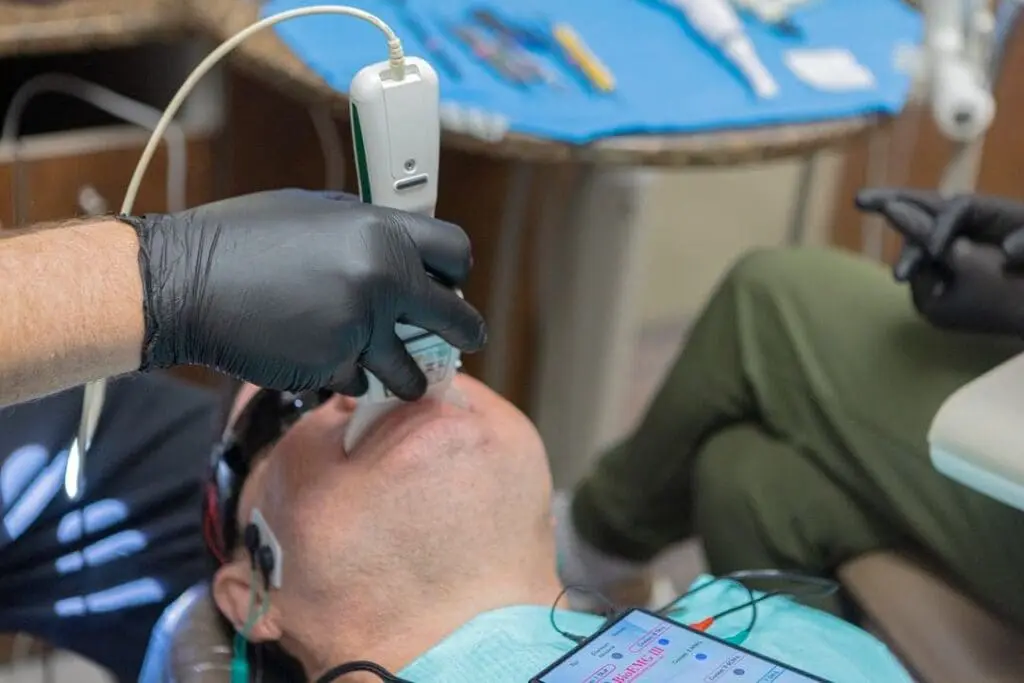
EMG stands for electromyography. In dentistry, EMG can be used to measure jaw muscle activity. Small sensors are placed over specific jaw muscles to record how active those muscles are during biting or jaw movement.
When DTR combines digital bite data with EMG muscle data, we can look at the bite and the muscles at the same time. This can help us see whether certain bite contacts are associated with increased muscle activity.
That is important because many patients with TMJ or jaw pain symptoms are not just dealing with the joint itself. Often, the muscles are a major part of the problem. Approximately 85% of all patients with TMJ symptoms are related to the overactivity of jaw-opening and closing muscles.
How Bite Timing Can Affect Jaw Muscles
Your jaw muscles are powerful. They help you chew, speak, swallow, and stabilize your jaw. But like any muscle group, they can become overworked.
If the back teeth rub or drag during side-to-side jaw movements, the muscles may stay active longer than they should. Over time, this may contribute to muscle fatigue, soreness, or tension.
A lot of our patients describe this as jaw tightness, soreness in the cheeks and temples, morning jaw fatigue, headaches, migraines, neck or facial tension, tooth sensitivity (especially cold sensitivity), an uneven bite, and clenching that feels hard to control.
Let’s be clear, not every TMJ problem is caused by the bite. TMJ disorders can involve the jaw joints, muscles, posture, airway, sleep, stress, trauma, arthritis, habits, and other factors.
But for many patients, bite timing and muscle activity are part of the big picture. DTR gives us a way to measure and treat that relationship more precisely.
Who Might Benefit from a DTR Evaluation?
A DTR evaluation may be helpful for patients who have symptoms such as jaw muscle soreness, TMJ discomfort, frequent tension-type headaches, migraine’s, gum recession, gum disease, anyone who has crowns or dental implants, clenching or grinding symptoms, tooth wear, chipped or cracked teeth, tooth soreness, loose teeth, uneven bite, facial muscle tension, pain when chewing, and cold sensitivity.
DTR can also be helpful in more advanced restorative or cosmetic dentistry cases. When crowns, veneers, implants, or full-mouth dentistry are involved, bite balance becomes especially important. Teeth and restorations are not just supposed to look good; they also need to function well under real-world bite forces.
However, DTR is not appropriate for every patient. A complete evaluation is needed first. Before recommending any treatment, we want to understand the condition of the teeth, muscles, joints, restorations, bite, airway, habits, and medical history.
What Happens During a DTR Consultation Appointment?
A DTR consultation appointment is usually much more detailed than a simple bite check. The goal is to gather objective information and understand how the teeth, muscles, and joints are functioning together.
1. Symptom Review
We start by discussing your symptoms. This may include jaw pain, headaches, migraines, tooth sensitivity, clenching, grinding, bite changes, prior dental work, sleep habits, and anything that seems to make the symptoms better or worse.
Patients often say things like “my bite feels off,” “I wake up with sore jaw muscles,” “I keep breaking teeth,” “My teeth feel sensitive to cold and I can’t eat ice cream but my dentist says I don’t have a cavity,” and “I have a nightguard, but my jaw still feels tight” These details will help to guide the evaluation.
2. Muscle and Joint Evaluation
Next, we evaluate the jaw joints and jaw muscles. This may include checking jaw range of motion, areas of tenderness, joint sounds, muscle tightness, and how the jaw moves.
This step matters because TMJ symptoms do not always come from the same source. Some patients have more joint-related issues, while others have the muscular form of TMJ. According to studies, approximately 85% of people with TMJ pain is actually muscle pain.
3.Digital Bite Computer
With T-Scan digital bite computer analysis, you simply bite down and move your jaw on a super-thin sensor. The computer records your bite contacts in real time.
This helps us see how your teeth contact during biting and during side-to-side jaw movements. Dr. Brian Orcutt can then evaluate which teeth are contacting, when they are contacting, and how force changes over time.
4. EMG Muscle Testing
Small electrode sensors are placed on the jaw muscles and record jaw muscle activity during the bite and side-to-side movement tests. This helps Dr. Brian Orcutt compare the bite data with muscle response.
The combination of T-Scan bite computer and the EMG can show us how the muscles react when the biting movements occur.
5. Data Review
After the measurements are taken, we review the data. We look for patterns such as prolonged posterior tooth contact, uneven force distribution, or muscle activity that stays elevated during movements.
This is where DTR is different from a traditional bite adjustment. The traditional way of adjusting the bite uses only bite paper, which has been shown to be 14% accurate. Using bite paper only is just an educated guess. The goal is to use objective measurements to guide the process.
6. Precise Bite Adjustments
If the data and exam findings indicate that bite adjustments may help, very small adjustments are made to specific areas. These adjustments are conservative and targeted. You do not need to be numb because it does not hurt and does not damage tooth structure if done properly. In fact, this only increases the chance for you to keep your teeth longer and have less risk of developing gum disease. It only improves the bite, never harms it.
The goal is to reduce problematic contacts that may be keeping the jaw muscles overactive during movement, among other benefits.
7. Re-Testing
After adjustments are made, the bite and muscle activity can be measured again. This allows us to confirm whether the changes improved the timing, force pattern, or muscle response.
This re-testing step is one of the most valuable parts of DTR because it gives us feedback beyond “how does it feel?” Re-testing is typically performed once a month for 2-3 months.
Is DTR the Same as a Nightguard?
No. DTR and nightguards are different.
A nightguard is an acrylic appliance that patients wear at nighttime to protect their teeth from grinding or clenching forces. You can still clench and grind, but the teeth won’t wear down like they will without a nightguard. It can be very helpful for many patients, especially those who grind at night, but it does nothing for TMJ and can sometimes even make your TMJ symptoms worse.
DTR, on the other hand, evaluates how the teeth function during movement and how the jaw muscles respond. It is not simply a protective appliance. It is a diagnostic and treatment approach that uses digital data to guide precise bite adjustments to allow your teeth to touch in the healthiest possible way.
Some patients may benefit from a nightguard. Some may benefit from DTR. Some may benefit from both. The right approach depends on the diagnosis and is something you should ask your dentist.
Is DTR Just “Grinding Down Teeth”?
This is a common concern, and it is an important one.
DTR is not about randomly grinding teeth. Proper DTR is a measured, data-guided process. The adjustments are typically microscopic and are based on digital bite timing, force analysis, muscle activity, symptoms, and clinical findings.
The purpose is to remove specific bite interferences that may be contributing to prolonged muscle activity or tooth stress. These bite interferences can break teeth, cause the start of gum disease, cause gum and bone recession, and lead to headaches and migraines as well as facial, jaw, and neck pain.
That said, any adjustment to teeth should be done carefully and only when appropriate. This is why diagnosis, training, technology, and certification in DTR therapy matter.
What Does the Research Say About DTR?
Research on DTR has evaluated the relationship between bite timing, jaw muscle activity, and symptoms in certain patients with muscular TMD or chronic myofascial pain.
Some studies have reported that reducing disclusion time with computer-guided bite adjustments can reduce muscle activity and improve symptoms in selected patients. This is one reason DTR has become an area of interest for dentists who focus on occlusion, TMJ symptoms, and bite-related muscle pain.
At the same time, it is important to keep the message balanced. TMJ disorders are complex. DTR is not a cure-all, and it is not the right treatment for every jaw pain patient. The best results come from careful diagnosis, proper case selection, and a comprehensive understanding of the patient’s symptoms. Most people can benefit from DTR, but not everybody is a candidate based on jaw structure and the degree of jaw joint disease.
Why a High-Tech Bite Evaluation Matters
Many patients with jaw pain have been told that everything “looks fine.” But when symptoms continue, it may be because the problem is functional rather than purely visual.
A tooth can look normal and still be overloaded. A bite can look acceptable and still have timing problems. A small interference can create a large muscle response in some patients. No dentist can see this with bite paper alone; high-tech evaluation is a must.
Digital bite analysis gives us a way to evaluate the bite in motion. EMG gives us a way to evaluate how the muscles respond to the bite. Together, these tools can provide a deeper understanding of the bite-muscle relationship.
For patients who have been frustrated by vague answers, this type of objective testing can be very helpful.
DTR and Restorative Dentistry
DTR is not only for patients with jaw pain. Bite timing can also matter when protecting dental restorations.
Crowns, veneers, fillings, implants, and other dental work all need to function within the bite. If certain teeth or restorations are overloaded, patients may experience porcelain chipping, crown sensitivity, repeated crown and filling fractures, tooth wear, sore teeth, cold sensitivity, bite discomfort, and loss of dental implants.
When we use digital bite technology, we can better evaluate how forces are distributed. This can be especially helpful after major restorative work, cosmetic dentistry, or bite changes.
Common Myths About DTR
Myth 1: TMJ problems are always caused by the bite.
Fact: TMJ problems can have many causes. The bite may be one factor for some patients, but it is not the only possible cause.
Myth 2: Bite paper tells the whole story.
Fact: Bite paper can show marks and tell dentists where the teeth are touching, but it does not measure timing, force, or muscle response.
Myth 3: DTR is the same as a regular bite adjustment.
Fact: A regular bite adjustment only used bite paper. DTR uses digital bite analysis and often muscle testing to guide precise adjustments.
Myth 4: Everyone with jaw pain needs DTR.
Fact: DTR is best for carefully selected patients after a complete evaluation. Some patients do not qualify for DTR if they have a certain jaw structure or if the pain actually stems from the joint itself. Once the joint is treated, then DTR may be considered if all the criteria are met.
Myth 5: A nightguard and DTR do the same thing.
Fact: A nightguard protects teeth from clenching and grinding forces. DTR evaluates and adjusts bite timing and pressure during jaw movements.
Frequently Asked Questions About DTR
Does DTR hurt?
The testing itself is non-invasive and never hurts. Patients bite on a thin sensor and perform guided jaw movements. If adjustments are made, they are typically very, very small and conservative.
How long does DTR take?
The length of the appointment depends on the complexity of the case. Some patients need a focused bite evaluation, while others require a more comprehensive TMJ and muscle assessment. Some patients require one to two treatments, and others need more. Typically, patients need two to three treatments; it just depends on the complexity.
Will DTR cure my TMJ problem?
DTR may help selected patients when bite timing and muscle overactivity are contributing to their symptoms. However, TMJ problems can have multiple causes, so no treatment should be presented as a guaranteed cure.
Can DTR help with headaches?
Some patients with jaw muscle overactivity also experience headaches or temple pain. If the muscles are being overworked because of bite timing issues, DTR may be one part of the treatment plan. A proper diagnosis is important because headaches can also have many non-dental causes.
Do I still need a nightguard?
Possibly. Some patients benefit from a nightguard, DTR, or a combination of both. It depends on your symptoms, bite, muscle activity, tooth wear, and risk factors.
Is DTR only for TMJ patients?
No. DTR may also be useful when evaluating tooth wear, cracked teeth, repeated restoration problems, bite discomfort, and complex restorative or cosmetic cases. DTR can only help improve your bite situation and always reduces your risk of fracturing your teeth, decreasing the likelihood of developing gum disease, and reducing the risk of bone and gum recession.
Why Choose Orcutt Family Dentistry for DTR in Fair Oaks, CA?
At Orcutt Family Dentistry, we take a comprehensive and technology-driven approach to all of the dental care we provide. When a patient has jaw pain, clenching symptoms, worn teeth, or a bite that feels uneven, we do not want to guess. We want to measure, evaluate, and understand what is happening. Dr. Brian Orcutt is proud to be the first, and only to date, dentist to become certified to perform DTR in the greater Sacramento area.
DTR allows us to look beyond simple bite marks and study the way the teeth and muscles function together. This can be especially valuable for patients with chronic jaw muscle tension, TMJ symptoms, bite discomfort, or repeated tooth stress.
Our goal is not to overtreat. Our goal is to identify the cause of the problem as accurately as possible and recommend care that makes sense for the patient. In fact, having a balanced bite through the DTR process is an extremely conservative approach because it reduces the risk of bad things happening to your teeth and jaws. Our motto at Orcutt Family Dentistry is “straight teeth last longer.” Dr. Brian Orcutt is known as the TMJ headache dentist in Fair Oaks.
Schedule a DTR or TMJ Fair Oaks Consultation
If you have jaw soreness, headaches, clenching, worn teeth, tooth sensitivity, or a bite that never feels quite right, a DTR evaluation may help determine whether your bite timing is contributing to your symptoms. At Orcutt Family Dentistry in Fair Oaks, we use advanced technology to evaluate the bite, jaw muscles, and TMJ system with greater precision.
We proudly serve Fair Oaks as well as Carmichael, Orangevale, Citrus Heights, Gold River, Rancho Cordova, Roseville, Folsom, and Sacramento. Call Orcutt Family Dentistry today or go to https://app.smilevirtual.com/brian-orcutt/sign-up to schedule a FREE Virtual TMJ Fair Oaks consultation.